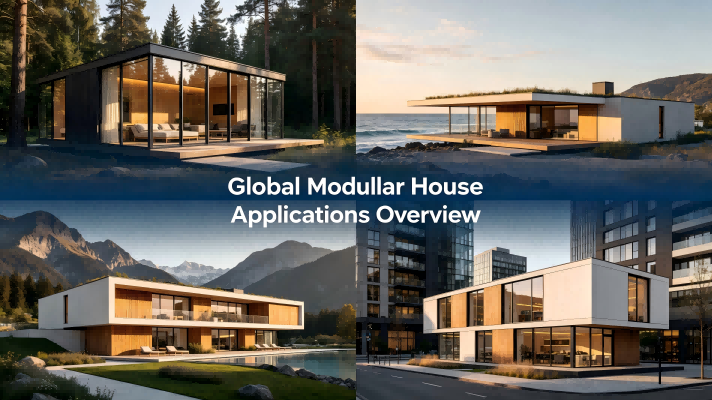
The construction industry is undergoing a significant transformation. With increasing demand for faster delivery, sustainable development, flexible space utilization, and lower environmental impact, traditional construction methods are facing new challenges.
For tourism developers, resort operators, rural revitalization planners, and commercial project investors, common problems often include:

A modern Modular House provides a new solution by combining industrial manufacturing technology with architectural design flexibility.
Unlike simple temporary buildings, professional modular houses are engineered building systems manufactured in controlled factory environments. Structural components, insulation systems, electrical wiring, plumbing, and interior finishing can be integrated before transportation and on-site installation.
For cultural tourism projects, this means developers can create:
with greater efficiency and flexibility.
Modern modular construction is also closely connected with sustainable building concepts, focusing on resource efficiency, reduced construction waste, and improved lifecycle performance.
Learn more about sustainable architecture concepts:
https://en.wikipedia.org/wiki/Sustainable_architecture
From an investment perspective, selecting a Modular House is not simply choosing a building product. It is a strategic decision involving:
| Decision Factor | Project Value |
|---|---|
| Construction Speed | Faster project launch and earlier operation |
| Design Flexibility | Adaptable layouts for different business models |
| Site Protection | Reduced impact on natural landscapes |
| Expansion Capability | Easier future development |
| Cost Control | Better predictability during construction |
For example:
A mountain resort may require independent accommodation units integrated into natural landscapes.
A coastal tourism project may need corrosion-resistant structures with panoramic views.
A rural wellness community may require accessible layouts and long-term comfort.
A professional Modular House solution allows these different scenarios to be planned through one flexible architectural system.

If you are planning a tourism resort, commercial development, or overseas modular construction project, our professional team can provide project consultation, customized design recommendations, and complete Modular House solutions.
One of the biggest misunderstandings among new investors is confusing Modular House systems with temporary buildings or basic container structures.
Although both may use prefabricated methods, they differ significantly in:
A professional Modular House is a complete building system manufactured through standardized production processes.
The typical production process includes:
This factory-based approach helps reduce uncertainty caused by weather conditions, labor shortages, and inconsistent construction quality.
| Comparison | Modular House | Traditional Construction |
|---|---|---|
| Production Method | Factory manufacturing | On-site construction |
| Construction Time | Shorter installation period | Longer building cycle |
| Quality Control | Factory inspection | Depends on site management |
| Expansion | Easier modification | More complex |
| Environmental Impact | Lower construction disturbance | Higher site impact |
The final investment cost of a Modular House depends on multiple factors rather than only the building size.
Main cost factors include:
Larger modules require more:
Different projects require different material systems.
Examples:
Pricing may vary depending on:
For overseas or remote projects, additional considerations include:
Before investing, project owners should evaluate:
✅ Manufacturer experience
✅ Engineering capability
✅ Material quality
✅ Production standards
✅ Installation support
✅ After-sales service
A suitable Modular House supplier should not only provide a product but also support the complete project process.
Learn more about prefabricated construction methods:
For tourism and commercial projects, choosing the correct Modular House size is directly related to operational efficiency.
A beautiful building with an unsuitable layout may result in:
Therefore, project planning should start from user requirements rather than simply selecting a standard model.
| Modular House Type | Typical Application |
|---|---|
| Compact Modular House | Camping cabins, short-stay accommodation |
| Medium Modular House | Resort rooms, holiday homes |
| Large Modular House | Villas, commercial spaces, multi-room units |
Recommended features:
A successful Modular House layout should balance:
Architectural planning resources can provide additional reference for spatial design principles.
Explore architectural design concepts:
One of the greatest advantages of a Modular House is the ability to combine standardized manufacturing with customized architectural design.
For tourism and commercial projects, standardized products may provide efficiency, but unique design elements are often essential for creating memorable destinations.
A successful Modular House project should not only meet functional requirements but also reflect:
For example:
A forest resort may require natural materials, panoramic windows, and stronger environmental integration.
A coastal holiday project may focus on open layouts, corrosion-resistant materials, and outdoor living spaces.
A wellness destination may prioritize accessibility, privacy, and comfortable indoor environments.
A professional customization process usually includes the following stages:
Before starting the design process, developers should define:
✔ Project location
✔ Building purpose
✔ Number of users
✔ Required functions
✔ Investment budget
✔ Local regulations
At this stage, manufacturers and designers evaluate whether the selected Modular House solution is suitable for the project environment.
After confirming project requirements, professional teams develop:
For tourism projects, architectural appearance is especially important because the building itself becomes part of the visitor experience.
Before production begins, technical teams usually confirm:
Digital design tools such as Building Information Modeling (BIM) are increasingly used to improve communication between architects, engineers, and manufacturers.
Learn more about Building Information Modeling (BIM):
Unlike traditional construction, Modular House production takes place in a controlled factory environment.
The manufacturing process usually includes:
This approach improves consistency and reduces construction uncertainty.
After factory completion, modules are transported to the project location.
The installation process generally includes:
For large-scale tourism or commercial projects, selecting the right manufacturer is as important as selecting the building design.
Professional evaluation criteria include:
| Evaluation Factor | Importance |
|---|---|
| Engineering capability | Ensures structural reliability |
| Customization experience | Supports unique project requirements |
| Production capacity | Affects delivery schedule |
| Quality control system | Ensures long-term performance |
| International experience | Helps overseas projects |
A reliable Modular House manufacturer should act as a project partner rather than only a supplier.
Need assistance with Modular House planning, drawings, customization, or manufacturer cooperation?
👉 Contact our professional team for project consultation and customized solutions.
The material system determines the long-term performance, appearance, and maintenance requirements of a Modular House.
For tourism and commercial applications, material selection should consider:
A mountain resort, coastal hotel, and urban commercial space may require completely different structural solutions.
Steel structures are widely used because of:
✔ High strength
✔ Good wind resistance
✔ Long service life
✔ Suitable transportation performance
Common applications:
Wood-based Modular House systems are popular in eco-tourism projects because they provide:
Suitable applications:
Composite materials provide advantages including:
Suitable for:
Modern Modular House design increasingly focuses on improving exterior appearance.
Advanced exterior systems can help modular buildings achieve:
For example, modern façade systems demonstrate how prefabricated buildings can achieve premium architectural aesthetics.
Explore modern façade and building envelope concepts:
| Environment | Recommended Considerations |
|---|---|
| Coastal Areas | Corrosion resistance and moisture protection |
| Mountain Areas | Wind resistance and structural strength |
| Cold Regions | Thermal insulation performance |
| Hot Regions | Ventilation and heat control |
A high-quality Modular House should consider:
Improves:
Especially important for:
Essential for:
Professional projects should comply with local building requirements and safety standards.
Learn more about building materials:
For tourism projects, one of the biggest advantages of a Modular House system is flexibility.
Developers can:
Prefab, container, and expandable modular systems are widely used in projects requiring fast deployment.
Prefab Modular Houses are manufactured mainly in factories and assembled at the project site.
✔ Stable quality
✔ Faster construction
✔ Reduced on-site labor
✔ Flexible customization
Suitable for:
Container-style Modular Houses are popular for projects requiring:
Common applications:
However, professional design is important to avoid the appearance of temporary construction.
Expandable Modular Houses provide additional flexibility through compact transportation and quick installation.
Advantages include:
✔ Reduced shipping volume
✔ Faster deployment
✔ Suitable for remote locations
✔ Easier relocation
They are especially suitable for:
Modern modular architecture increasingly focuses on reuse and adaptability.
Compared with fixed traditional buildings, modular systems may provide more opportunities for:
Container architecture has also become an important topic in alternative building research.
Learn more about shipping container architecture:
| Type | Best Application | Main Advantage |
|---|---|---|
| Prefab Modular House | Resorts & permanent projects | Stable quality |
| Container Modular House | Commercial spaces | Flexible investment |
| Expandable Modular House | Remote projects | Easy transportation |
Explore our Modular House solutions, product categories, and customized project options:
👉 Visit Our International Store
In the past, many people associated Modular House with simple temporary buildings. However, modern modular architecture has developed significantly.
Today, luxury Modular House solutions combine:
For high-end tourism projects, the building itself is no longer only a functional space. It becomes an important part of the guest experience.
A carefully designed Modular House can help create:
Modern minimalist design focuses on:
Suitable for:
✔ Urban vacation homes
✔ Contemporary resorts
✔ Premium accommodation projects
Wood-style modular architecture is widely used in nature-based tourism projects.
Key characteristics:
Suitable for:
Luxury modular villas often include:
These designs are suitable for:
Many investors believe that luxury modular buildings are always more expensive.
However, total project value should consider the complete lifecycle:
| Factor | Traditional Construction | Modular House |
|---|---|---|
| Construction period | Usually longer | Faster installation |
| Site impact | Higher | Lower |
| Expansion ability | Limited | Flexible |
| Cost prediction | More uncertain | Easier management |
A professional Modular House solution focuses not only on initial investment but also:
Modern architectural media increasingly highlight modular and prefabricated buildings as innovative approaches to sustainable design.
Explore global architecture and design inspiration:
Premium projects often include:
Benefits:
Possible integrations:
Examples:
These elements help transform a Modular House from a simple building into a complete tourism experience.
Planning a luxury resort, eco-tourism destination, or customized Modular House project?
👉 Contact our team for professional design consultation and project solutions.
The application scope of Modular House has expanded far beyond traditional residential use.
Today, modular construction is widely applied in:
For project developers, one modular system can support multiple business scenarios.

Residential applications include:
Features:
Suitable for:
Modular Houses help rural projects achieve:
Important requirements:
Commercial modular buildings are increasingly popular because they can be deployed quickly.
Examples:
Suitable for:
Applications:
Suitable for:
Modular construction can also support:
For tourism investors, modular solutions provide several strategic advantages:
Shorter construction periods allow projects to begin operation earlier.
Developers can add additional units according to:
Compared with traditional construction, modular solutions can reduce disturbance to natural landscapes.
Sustainable tourism development increasingly emphasizes low-impact construction approaches.
Learn more about sustainable tourism concepts:
Many homeowners, architects, and developers share experiences about modular living, construction challenges, and design ideas through online communities.
Explore modular housing discussions:
Explore Modular House models, application solutions, and customized project options:
👉 Visit Our International Store
With increasing demand for sustainable and efficient construction solutions, Modular House projects are expanding into global markets.
However, overseas modular projects require more than product transportation.
Successful international delivery requires consideration of:
Different regions require different solutions.
Important requirements:
Every country has different construction requirements.
Before export, professional evaluation should consider:
International building standards provide important references for global construction projects.
Learn more about International Building Code concepts:
International Modular House delivery requires careful planning:
✔ Module size confirmation
✔ Packaging protection
✔ Transportation method selection
✔ Local transportation
✔ Crane installation
✔ Utility connection
Different regions show different demands:
| Market | Application Focus |
|---|---|
| Europe | Sustainable housing & tourism |
| North America | Residential modular solutions |
| Australia | Rural and remote accommodation |
| Southeast Asia | Resort and hospitality projects |
【CTA - Insert Contact Us Link Here】
Looking for a Modular House solution adapted to your overseas market?
👉 Contact our international project team for consultation.
Portable Modular House systems provide additional flexibility for projects requiring mobility.
They are suitable for:
Portable systems allow businesses to adjust locations according to:

Compared with permanent construction, portable modular solutions provide:
Common accessories include:
Portable architecture has become an important topic in flexible construction.
Learn more about portable building concepts:
The development of modern construction is moving toward:
A successful Modular House project requires comprehensive consideration of:
✔ Project purpose
✔ Location conditions
✔ Design requirements
✔ Material selection
✔ Installation planning
✔ Long-term operational value
For tourism developers, investors, architects, and international project owners, Modular House is not only a construction method but also a strategic solution for creating adaptable future spaces.
From eco-resorts and luxury villas to commercial facilities and overseas housing projects, modular architecture is reshaping the way buildings are designed, manufactured, and delivered.
Whether you are developing:
our professional team can provide:
✓ Customized Modular House solutions
✓ Architectural planning support
✓ Product recommendations
✓ Project implementation guidance
👉 Visit Our International Store
Continue exploring our complete Modular House knowledge series: